
Why Florida Businesses Need Workers’ Compensation Insurance
Workers comp quotes Florida are essential for protecting your business from the financial fallout of workplace injuries while ensuring you comply with state law. Most Florida businesses with four or more employees must carry this insurance, and construction companies need it from their very first hire.
Quick Answer: How to Get Workers Comp Quotes in Florida
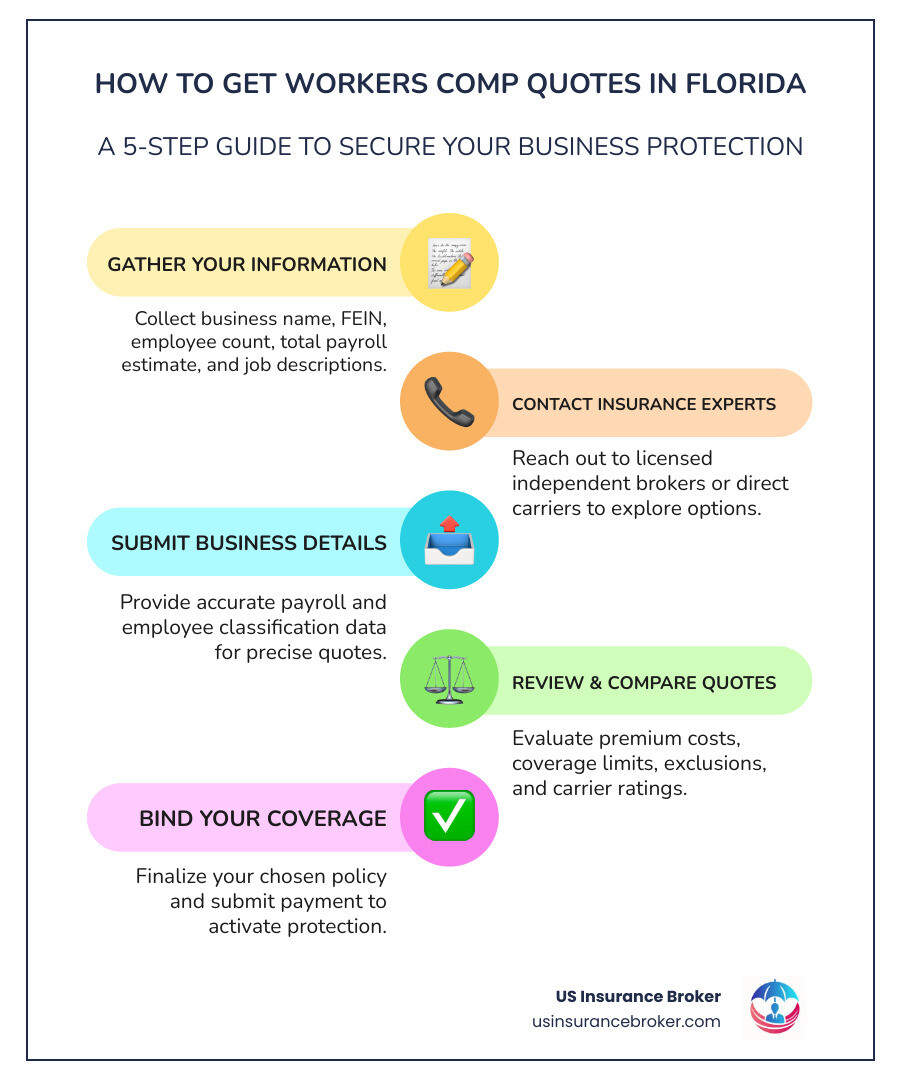
- Gather your information: Business name, FEIN, employee count, payroll, and job descriptions.
- Contact licensed brokers or carriers: Independent agents can compare multiple carriers for you.
- Submit your business details: Provide accurate payroll and employee classification data.
- Review and compare quotes: Analyze premium costs, coverage limits, and carrier ratings.
- Bind your coverage: Submit payment to activate your policy.
Average Florida Cost: $1.50 to $1.99 per $100 in payroll, with rates declining since 2016.
Workers’ compensation protects both you and your employees. If an employee is injured on the job, it covers their medical bills, rehabilitation, and lost wages. For your business, it provides crucial protection from lawsuits and helps you avoid penalties like stop-work orders. Non-compliance can lead to fines equal to twice the amount you would have paid in premiums for two years.
Despite serious consequences, many business owners struggle with the complex requirements. The good news is that Florida’s rates have been declining for years, making it more affordable than ever to get compliant. I’m William Kane II, owner of Forever Florida Insurance, and I help Florida businesses steer the process. With access to 30+ top-rated carriers, I can help you find affordable protection without the confusion.
Basic workers comp quotes florida glossary:
Understanding Florida’s Workers’ Comp Requirements

Before shopping for workers comp quotes Florida, you must know if your business needs coverage. Florida’s requirements depend on your employee count and industry.
- Non-construction businesses must have coverage if they have four or more employees (full-time or part-time).
- Construction companies face stricter rules, needing coverage from the very first employee. General contractors are also liable for uninsured subcontractors working on their sites.
- Agricultural businesses need coverage if they employ six or more regular employees or 12 or more seasonal workers for over 30 days.
The consequences for non-compliance are severe. Florida’s Division of Workers’ Compensation issues about 2,500 stop-work orders annually, forcing businesses to shut down until they secure a policy and pay hefty penalties. Fines can equal twice the premium you would have paid for the past two years. Furthermore, without coverage, an injured employee can sue you directly.
For more details, see our guides on Does Florida Require Workers Compensation Insurance? and Workmans Comp Florida Rules.
Who is Exempt from Workers’ Comp in Florida?
Florida law allows specific exemptions that can help reduce your premium costs, but they come with risks.
Sole proprietors and partners are automatically exempt. However, if you are injured on the job, your personal health insurance likely won’t cover it, leaving you to pay for medical bills and lost income out-of-pocket.
Corporate officers and LLC members can choose to exempt themselves by filing with the state. Up to three officers in a non-construction business can opt out, while only one officer in a construction company can be exempt. You must file an exemption application to make it official.
Before exempting yourself to save money, consider the trade-off. An exempted owner who gets injured has no coverage for medical expenses or lost wages. For some, the savings are worth it; for others in high-risk industries, keeping coverage is the smarter financial move.
Our Workmans Comp Waiver Florida Guide can help you decide if an exemption is right for you.
What Florida Workers’ Comp Covers (and What It Doesn’t)

When comparing workers comp quotes Florida, it’s crucial to understand what a policy covers. It’s a safety net for both your employees and your business.
When an employee is hurt on the job, workers’ comp provides several key benefits:
- Medical Expenses: Covers everything from emergency room visits and surgery to prescriptions and physical therapy. The employee won’t see a bill for approved care.
- Lost Wages: Replaces a portion of the employee’s income while they recover. In Florida, this is typically two-thirds of their average weekly wage.
- Rehabilitation Services: Includes physical, occupational, and vocational therapy to help employees return to work. It may even cover retraining for a new career if they can’t return to their old job.
- Disability Benefits: Provides compensation for employees who suffer permanent impairment from a workplace injury.
For employers, this coverage is a critical shield. By providing these no-fault benefits, workers’ compensation acts as an “exclusive remedy,” meaning employees generally cannot sue your business over work-related injuries. This protects you from potentially ruinous lawsuits. Learn more in our What Is Workers Comp? guide. If you have an injured employee, our Injured At Work Florida Guide can help.
What is Not Covered by Workers’ Comp?
Workers’ comp is comprehensive but has limits. Coverage is typically denied for:
- Injuries caused by intoxication or illegal drug use.
- Self-inflicted injuries.
- Injuries from a fight started by the employee.
- Injuries that happen outside the scope of employment, such as during a commute or on a personal lunch break.
- Claims filed after an employee is fired or laid off, which face heavy scrutiny.
Workers’ comp also does not cover OSHA fines for safety violations.
Florida Workers’ Compensation Death Benefits
In the tragic event of a fatal workplace accident, Florida workers’ compensation provides death benefits to the surviving family.
- Funeral expenses are covered up to $7,500.
- Dependent support is provided to the surviving spouse and minor children, typically at 66.67% of the deceased’s average weekly wage.
Total death benefits are capped at $150,000 in Florida. These benefits provide critical financial stability during an impossibly difficult time.
Calculating the Cost: Factors Influencing Your Florida Quote
When you seek workers comp quotes Florida, the main question is always, “What will this cost?” There’s no single answer, as your premium is unique to your business. Understanding the calculation, however, puts you in control.
Florida businesses typically pay between $1.50 and $1.99 per $100 in payroll. The good news is that rates have been dropping annually since 2016, making coverage more affordable. Several key factors determine your final price:
- Payroll Size: Your total annual payroll is the foundation of the premium calculation. More payroll means more potential exposure for the insurer.
- Industry Risk & Classification Codes: Insurers use codes from the National Council on Compensation Insurance (NCCI) to set rates based on risk. A roofer faces far greater hazards than an office worker, so their rate is much higher. It’s critical to classify each employee accurately based on their specific job duties to ensure a correct premium.
- Experience Modification Rate (EMR): This is your safety report card. An EMR of 1.0 is average. A strong safety record with few claims can earn you a lower EMR (e.g., 0.80 for a 20% discount), while a poor claims history will result in a higher EMR (e.g., 1.20 for a 20% surcharge).
- Claims History: Your history of past claims (“loss runs”) directly impacts your EMR and rates for years. Preventing injuries is the best way to control costs.
The basic formula is: Premium = (Classification Rate / $100) x Payroll x Experience Modification Rate. For more on pricing, see our Business Insurance Quotes Guide.
How to Save Money on Your Workers’ Comp Insurance
You have significant control over your workers’ comp costs. Here are proven strategies to lower your premiums:
- Implement a Workplace Safety Program: This is the most effective way to reduce costs. Fewer injuries mean fewer claims and a lower EMR. Formal training, safety equipment, and a culture of safety pay dividends.
- Ensure Accurate Employee Classification: Don’t classify your office manager the same as your field crew. Correct classification prevents overpayment and audit penalties.
- Consider Pay-As-You-Go Plans: If your payroll fluctuates, these plans base your premium on actual payroll each pay period. This improves cash flow and avoids large audit bills.
- Choose a Higher Deductible: Agreeing to pay more out-of-pocket per claim can lower your premium. This is a good strategy for businesses with strong cash reserves.
- Exempt Qualifying Owners/Officers: If you are eligible, formally exempting owners can reduce your total payroll and premium. Review the risks in our Workmans Comp Waiver Florida Guide.
To see how classification impacts cost, consider a business with $100,000 in payroll:
| Employee Type | Base Rate (per $100 payroll) | Estimated Annual Premium |
|---|---|---|
| Clerical Office Employee | $1.00 | $1,000 |
| Landscaper | $2.88 | $2,880 |
| Roofer | $18.18 | $18,180 |
This table clearly shows why accurate classification and safety are essential for managing your insurance costs.
How to Get Workers Comp Quotes Florida: A Step-by-Step Guide
Now for the practical part: getting workers comp quotes Florida and choosing a policy. You have several options for where to buy coverage.
- Independent Insurance Brokers: This is often the best path. A broker like Forever Florida Insurance works with dozens of carriers, shopping the market on your behalf to find the best combination of price and coverage. We act as your advocate, simplifying the process.
- Direct from Insurance Companies: You can contact insurers one by one, but this is time-consuming and limits your ability to compare the market effectively.
- Florida Workers’ Compensation Joint Underwriting Association (FWCJUA): This is the state’s “insurer of last resort” for high-risk businesses that can’t find coverage elsewhere. Premiums are typically higher.
- Professional Employer Organizations (PEOs): PEOs co-employ your staff and handle HR, including workers’ comp. This can simplify administration but may not be the most cost-effective solution.
- Self-Insurance: An option for very large corporations with the financial resources to cover their own claims, this is not realistic for most small or mid-sized businesses.
For most Florida businesses, an independent broker offers the best value. Learn more at our Workers Comp Insurance page.
What Information is Needed for workers comp quotes florida?
To get accurate workers comp quotes Florida, gather this information beforehand:
- Business Identification: Legal business name, address, and Federal Employer Identification Number (FEIN).
- Employee Information: Total number of full-time, part-time, and seasonal employees.
- Job Descriptions: A detailed breakdown of what each employee does. This is critical for accurate classification and pricing.
- Estimated Annual Payroll: Your total projected payroll for the year, including wages, salaries, and bonuses.
- Claims History: A “loss run” report from your prior carrier detailing claims from the last 3-5 years. New businesses won’t have this.
- Business Details: Your legal structure (LLC, Corp, etc.) and years in business.
Comparing Your workers comp quotes florida
Don’t just pick the cheapest quote. A thorough comparison involves looking at several factors:
- Premium Cost and Payment Options: Compare the total annual premium and see what payment plans are offered (e.g., pay-as-you-go, monthly, annually).
- Coverage Details: Check the Employer’s Liability limits. Standard limits are often $100k/$500k/$100k, but you may want to purchase more.
- Carrier Financial Strength: Look for insurers with high ratings (e.g., “A” or better from A.M. Best). You need a carrier that will be financially stable for years to come.
- Claims Handling and Service: Research the carrier’s reputation for handling claims. Are they responsive and fair? Do they offer local support and online policy management?
- Value-Added Services: Some carriers offer free loss control services, safety training materials, and other resources to help you prevent claims.
An experienced independent broker helps you analyze these factors, ensuring you get the right policy from a reliable carrier, not just the lowest price.
Navigating the Florida Claims Process and Finding Resources
Even with great safety measures, accidents happen. Knowing the claims process is key to a smooth recovery for your employee and protection for your business.
Initial Steps After an Injury
- Employee Notifies Employer: The employee should report the injury to you as soon as possible. While the law allows up to two years to file, prompt reporting (within 30 days) is best practice. Our Injured At Work page has more info for employees.
- Employer Directs Medical Care: You should direct the employee to an authorized medical provider within your workers’ comp network.
Your Responsibilities as an Employer
- Report the Claim: You must report the injury to your insurance carrier within seven days of being notified. This is required by law.
- Inform the Employee: Provide the injured worker with information about their rights and responsibilities under the workers’ comp system.
The Claims Process
The Florida statute of limitations for filing a claim is generally two years from the date of injury. Once you report the claim, your carrier will investigate to confirm it’s work-related. If approved, the carrier will cover medical treatments and provide income benefits for lost wages. The employee has the right to receive appropriate care and appeal any decisions they disagree with.
Where to Turn for Help
The claims process can feel complex, but resources are available. The Florida Division of Workers’ Compensation is the state agency that oversees the system. Their website offers guides, forms, and contact information for both employers and employees.
Getting competitive workers comp quotes Florida is the first step. Understanding how to use that coverage is what truly protects your business and your team.
Secure Your Florida Business Today
Navigating workers comp quotes Florida doesn’t have to be a challenge. This guide has outlined the path to understanding requirements, controlling costs, and securing the right coverage.
Key takeaways:
- Compliance is Mandatory: Florida’s rules are strict, and penalties are severe.
- It’s Dual Protection: Workers’ comp shields your employees with benefits and your business from lawsuits.
- You Can Save Money: Proactive safety, accurate classifications, and smart policy choices lower your premiums.
- Local Expertise is Key: Understanding the Florida market is crucial for finding the best coverage.
At Forever Florida Insurance, we make insurance simple for Floridians. Serving Tampa, Clearwater, St Petersburg, and the Gulf Coast, we understand the local business landscape.
Don’t leave your business vulnerable. Let us help you find competitive workers comp quotes Florida that fit your budget and protect your team. Protecting your employees means protecting your future.
Get A Quote today, or Contact Us to speak with an experienced broker. Start the process of securing your business with a comprehensive workers’ comp policy.